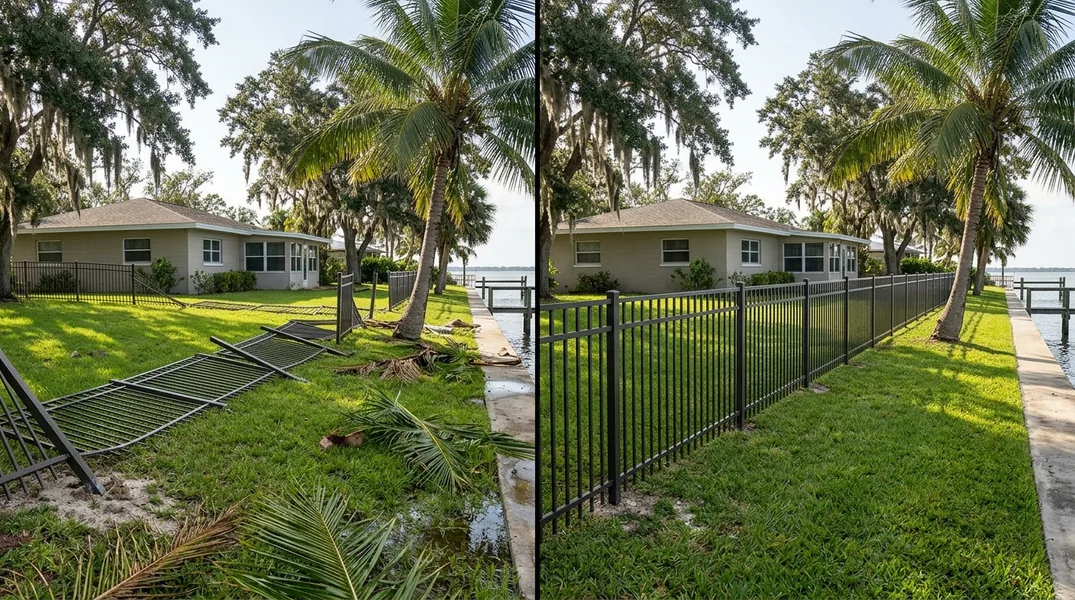
Understanding Storm Surge vs. Wind Damage
When a hurricane threatens St. Petersburg, homeowners often focus on their homes and roofs, but fences take a serious beating too. However, not all hurricane fence damage is created equal. The two primary culprits, storm surge and wind, cause distinctly different types of damage to your fence, and understanding the difference matters when it comes to repairs and insurance claims.
Storm surge is the rapid rise in water level caused by a hurricane's intense low pressure and powerful winds pushing ocean water inland. In St. Petersburg, which sits on the coast of Tampa Bay, storm surge can push water several feet above normal tide levels, inundating neighborhoods and submerging fences entirely. Wind damage, by contrast, is the direct force of hurricane-force winds that can exceed 150 miles per hour, snapping boards, uprooting posts, and twisting fence sections out of alignment. Both can devastate your property, but they require different repair approaches and may be treated differently by your homeowners insurance.
How Storm Surge Damages Fences
Storm surge damage to fences is often more insidious than it first appears. When saltwater floods across your property, it doesn't just knock over your fence, it saturates the soil around fence posts, weakening the foundation that holds them upright. For Wood & Privacy Fence Installation, this is particularly problematic because wood is porous and absorbs moisture rapidly. The saltwater accelerates rot and decay, compromising the structural integrity of the fence long after the water recedes.
Beyond the immediate submersion, storm surge leaves behind sand, debris, and salt deposits that can cause additional problems. Salt crystallizes on fence materials and in the soil, drawing moisture toward the fence structure and promoting rust in metal components. Wooden fence posts may appear intact immediately after a storm but fail months later due to hidden rot developing beneath the soil line. Homeowners often underestimate storm surge damage because the fence might still be standing when the water drains away, only to discover serious problems when they try to repair or reinforce weak sections.
Wind Damage: The Immediate and Obvious Threat
Hurricane-force winds are less subtle than storm surge. When winds exceed 100 miles per hour, they exert tremendous lateral pressure on fence panels and posts. Boards snap cleanly, posts lean or uproot entirely, and entire sections of fencing can be torn away and scattered across your yard or into your neighbor's property. The damage is usually visible immediately, and homeowners can often point to exactly where and how the fence failed.
Wind damage tends to be more uniform across fence types. Whether you have Vinyl & PVC Fence Installation, Chain Link Fence Installation, or wooden fencing, hurricane winds will find weak points and exploit them. Posts that weren't set deep enough or concrete footings that didn't cure properly are especially vulnerable. Vinyl fencing becomes brittle in high winds, while chain link fences can be bent or torn. The advantage of wind damage, from a homeowner's perspective, is that it's straightforward to document and typically easier to repair than the hidden decay caused by storm surge.
Does Homeowners Insurance Cover Fence Damage
This is the question every homeowner asks after a hurricane: does homeowners insurance cover fence damage? The answer is complicated and depends on your specific policy, the cause of damage, and your insurance company's interpretation of your coverage. Most standard homeowners insurance policies do not cover fence damage as part of the dwelling coverage, treating fences as separate structures on your property with limited or no protection.
However, some policies include limited coverage for fences under the 'other structures' provision, which typically covers detached structures like sheds, garages, or guest houses. This coverage is usually capped at 10 to 15 percent of your dwelling coverage limit, so if your home is insured for $300,000, your fences might only be covered up to $30,000 to $45,000 at most. Additionally, many policies exclude damage from flooding or storm surge entirely, even though these are common in hurricane-prone areas like St. Petersburg. Wind damage is more likely to be covered than water damage, but you'll need to review your policy carefully and contact your insurance agent to confirm what's included.
The best approach is to contact your insurance company immediately after a hurricane and document all damage with photographs and video. Keep records of any debris removal or temporary repairs you make to prevent further damage, as these expenses might be reimbursable. If your claim is denied or you disagree with the settlement, you have the right to dispute it, but having clear documentation makes the process smoother.
Storm Damage Fence Repair: When to Call a Professional
After a hurricane, your first instinct might be to grab a hammer and fix the fence yourself, but storm damage often requires professional assessment. A fence that looks repairable might have hidden structural problems, especially if it was damaged by storm surge. Posts that appear straight might be weakened by rot, and boards that seem intact might be cracked internally. Attempting repairs without professional evaluation can result in a fence that fails again during the next storm or collapses unexpectedly.
St. Petersburg Fence Company specializes in assessing and repairing hurricane damage to all fence types. Our team can identify whether your fence needs simple repairs or complete replacement, and we can help you understand what your insurance might cover. We work with homeowners and insurance adjusters to ensure repairs meet local building codes and are completed safely. Whether your fence suffered wind damage, storm surge damage, or a combination of both, we can provide a detailed assessment and free estimate for repairs or replacement. Call us at (727) 591-6938 to schedule an inspection.
Rebuilding Your Fence After Hurricane Damage
Once you've assessed the damage and worked through insurance claims, rebuilding is the next step. This is an opportunity to consider whether your original fence is still the best choice for your property. If your wooden fence suffered storm surge damage, you might want to explore Vinyl & PVC Fence Installation, which is more resistant to salt water and rot. If wind was the primary culprit, reinforcing your fence with deeper post footings or upgrading to a more wind-resistant material like Aluminum & Ornamental Iron Fencing could prevent similar damage in future storms.
When rebuilding, ensure that new installations comply with local building codes and hurricane-resistant standards. Proper post depth, concrete footing quality, and spacing between boards all contribute to wind resistance. If you're in a flood-prone area, consider materials and designs that allow water to flow through rather than resist it, reducing the pressure on your fence during storm surge. St. Petersburg Fence Company can help you choose materials and designs that balance aesthetics with resilience. Contact us at (727) 591-6938 or visit our website to discuss your options and get a free estimate for your new fence installation.
Looking for a professional fence contractor in St. Petersburg? St. Petersburg Fence Company responds fast for all your fence needs.
Get a Free Quote