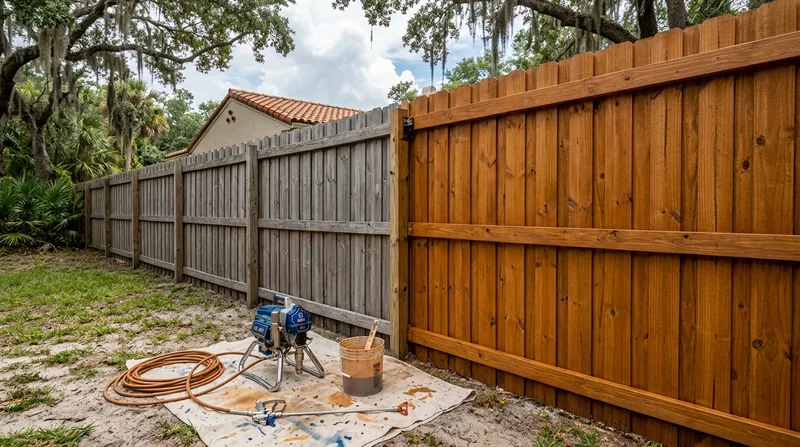




Cedar and pressure-treated wood fences in St. Petersburg take a beating from the Gulf Coast sun, salt air, and the relentless afternoon humidity that builds into thunderheads almost daily through the summer wet season. A fence staining and restoration service cleans, brightens, and seals the wood, halting the graying and checking that turns a solid fence into a weathered shell within a few years. Done right, staining can double the remaining life of the wood under these conditions, and we tell you plainly when the fence still justifies the investment and when the damage has gone too far. We are fully insured and have been doing this work since 2015 across St. Petersburg, Clearwater, Largo, and the barrier islands. If your cedar or pine fence is graying, splintering, or showing dark mold patches from moisture, we can help you decide whether restoration makes sense or whether replacement is the smarter spend.
Why Fence Staining & Restoration Matters in St. Petersburg's Humid Climate
Wood fences on the St. Petersburg peninsula face a specific set of stressors that accelerate decay and discoloration. The combination of high humidity, salt spray from Tampa Bay and the Gulf, intense UV exposure, and standing water after summer storms creates ideal conditions for mold, mildew, and wood fiber breakdown. Cedar and pressure-treated pine lose their color within two to three years without protection, and untreated wood can begin to rot at the posts and rails long before the visible damage becomes obvious.
Staining and sealing stop that clock. A quality stain penetrates the wood fiber, blocks UV rays, sheds water, and prevents the fungi and mold that thrive in Florida's moisture. The result is wood that holds its strength and appearance for years longer, and a fence that does not need replacement as soon as it otherwise would.
- We clean the fence thoroughly to remove mold, mildew, and weathered surface fibers before staining begins.
- We apply a penetrating stain that protects the wood from UV damage and moisture penetration for 3 to 5 years.
- We seal joints, caps, and trim to prevent water from pooling and entering the grain where rot starts.
- We assess the condition of posts, rails, and pickets and recommend repair or replacement where the wood has already failed.
A fence that is cleaned, stained, and sealed properly will hold its color and structure through multiple Gulf Coast summers and will not need full replacement nearly as soon as an unprotected fence.
Key info: In neighborhoods like Old Northeast, Kenwood, and Historic Uptown, where mature live oak canopy and salt air combine, wood fences gray and mold quickly. Staining extends the life of cedar fencing in these blocks by years, and prevents the kind of deep rot that forces full replacement. Homeowners who stain every 4 to 5 years keep their fences looking new and structurally sound.
For more on how to keep your fence in top condition, see our fence repair page, which covers post replacement and rail damage.
How We Clean, Stain, and Seal Your Fence: Our Process
Fence staining done right is a multi-step process. We do not simply brush stain over a dirty fence. We start by assessing the wood condition, identifying any rot or structural damage, and then cleaning the entire surface to bare wood before applying sealer and stain. This approach ensures the stain bonds properly and lasts as long as it should.
The work is physically demanding and requires the right equipment and materials. We use pressure washing (at controlled PSI to avoid gouging the wood), hand scraping where needed, and professional-grade stains rated for Florida's climate. The job typically takes one to three days depending on fence length and condition, and we work around your schedule.
- We pressure wash the fence at a safe PSI to remove dirt, mold, and weathered surface fibers without damaging the wood grain.
- We hand scrape and sand any rough patches, splintered areas, or stubborn mold that pressure washing does not remove.
- We let the wood dry fully (typically 24 to 48 hours depending on humidity) before applying stain.
- We apply two coats of penetrating stain in the color you choose, ensuring even coverage on all surfaces and edges.
- We seal all cap boards, trim, post tops, and joints with a water-resistant sealant to prevent water entry at vulnerable points.
The result is a fence that looks fresh, repels water, and resists UV damage for years to come.
Example: A homeowner in St. Pete Beach with a cedar privacy fence backing onto the Gulf had neglected staining for five years. The fence was gray, soft to the touch in places, and showing mold on the shaded north side. We cleaned it, found that two corner posts were rotted and needed replacement, stained the sound wood, and sealed all joints. The fence went from a liability to a solid privacy barrier with an expected 4 to 5 more years of life. That repair and staining cost less than a third of a full fence replacement.
For details on fence post replacement and structural repair, see our fence post repair page.
Staining Methods and When to Use Each
| Approach | Description | Best for |
|---|---|---|
| Penetrating Semi-Transparent Stain | Soaks into the wood grain, shows the natural wood color and texture underneath, lasts 3 to 5 years. | Cedar fences in good condition where homeowners want to see the wood character and color. |
| Solid Color Stain | Opaque finish that covers the wood surface, hides grain and color variation, provides maximum UV protection, lasts 4 to 6 years. | Pressure-treated pine fences or wood in poor cosmetic condition that needs a uniform finished look. |
| Water-Based Stain | Low VOC, quick-drying, easy cleanup, good for environmentally sensitive areas, requires more frequent recoating. | Neighborhoods with strict environmental standards or homeowners who prioritize low odor and fast turnaround. |
| Oil-Based Stain | Deeper penetration, richer color, longer-lasting protection, requires adequate ventilation and drying time in Florida humidity. | Cedar fences in premium neighborhoods where durability and appearance justify the longer drying period. |
Each method has trade-offs in durability, appearance, and labor. We recommend the stain type based on your wood type, the fence condition, and how long you want the finish to last before the next staining cycle.
Fence Staining & Restoration Cost in St. Petersburg: What to Expect
The cost of fence staining in St. Petersburg starts at around $950 for a small residential fence (under 100 linear feet) and scales up based on fence length, wood condition, and the scope of repairs needed. Most homeowners spend between $1,200 and $2,500 for a typical privacy fence in the 150 to 300 linear foot range. Large estates, fences in poor condition requiring significant post replacement, or jobs in high-end neighborhoods can run higher.
The main factors that move the cost are fence length (measured in linear feet), the condition of the wood going in (clean wood costs less to stain than wood with heavy mold or soft rot), whether posts need replacement, and the type and quality of stain you choose. A fence with a few rotted posts will cost more than one needing only cleaning and staining. A semi-transparent stain costs less than a solid color stain. Travel across St. Petersburg, Clearwater, and Largo is included with no separate fee.
The best way to know what your fence will cost is to get a free estimate. Call (727) 591-6938 and we will schedule a walk-through. We measure the fence, assess the wood, identify any repairs, and give you a clear price before we start work. We also explain what you are paying for, so you understand the difference between a quick paint job and proper fence restoration that will last.
For a full pricing overview across all our services, see our pricing page.
What to Look for When Hiring a Fence Contractor Near Me in St. Petersburg
Hiring a fence contractor is a decision that affects the longevity and appearance of your property. The right contractor will be honest about what your fence needs, will not oversell you on replacement when repair is the smarter choice, and will stand behind the work. Here is what to check before you hire.
First, confirm that the contractor carries general liability and workers' compensation insurance. We are fully insured and can provide a certificate of insurance on request. Ask for references from recent jobs in your neighborhood, and call at least two of them. In St. Petersburg, fence licensing is set at the county and municipal level and varies by jurisdiction and job scope. Ask your local building department whether a permit is required for your staining project. Most staining work does not require a permit, but some jurisdictions have rules if your fence is in a historic district or protected neighborhood like Old Northeast or Kenwood.
If your fence is in an HOA-governed community, check your architectural guidelines before you stain. Some HOAs restrict stain colors or require approval before work begins. Get multiple estimates, at least two or three, and do not choose based on price alone. A low bid often means the contractor is cutting corners on prep work or stain quality. Ask what is included in the estimate: does it cover post replacement, does it include sealing joints, and is it a one-coat or two-coat stain application?
- Verify that the contractor carries general liability and workers' compensation insurance with a certificate available on request.
- Ask for references from at least two recent jobs in your area and call them to ask about quality, timeliness, and cleanup.
- Check with your city or county building department to confirm whether a permit is required for staining in your zone or historic district.
- Review your HOA architectural standards if your property is in a master-planned community, as some restrict stain colors or require prior approval.
- Get written estimates from multiple contractors that clearly describe scope, stain type, post repair, and timeline.
- Avoid the lowest bid if it seems significantly cheaper than others, as it often reflects lower quality materials or rushed prep work.
A contractor who takes time to understand your fence, explains the options, and gives you a clear written estimate is one you can trust to do the job right.
When you are ready to move forward, contact us for a free estimate. We respond within 24 hours and will walk you through the entire process.
Fence Staining & Restoration in St. Petersburg: Pricing Guide
| Service | Price | Details |
|---|---|---|
| Small residential fence (under 100 linear feet) | Starting at $950 | Includes cleaning, two-coat stain, and sealing. Ideal for small yards or townhome fences in St. Petersburg neighborhoods. |
| Medium privacy fence (150 to 300 linear feet) | Starting at $1,200 | Full cleaning, stain, seal, and minor post assessment. Most common scope for St. Petersburg residential properties. |
| Large estate or fences requiring post replacement | On estimate | Rotted posts, extensive mold, or structural damage require on-site assessment before pricing can be accurate. |
| Rush or emergency staining | On estimate | Expedited scheduling and weekend availability available; contact us for availability and pricing. |
| Travel across service area | Included | No separate travel fee for St. Petersburg, Clearwater, Largo, Pinellas Park, Seminole, and surrounding areas. |
| Free estimate and consultation | Free | No obligation. Response within 24 hours at (727) 591-6938. We walk your fence and give you a clear written price. |
Indicative pricing, the exact cost depends on square footage, finish, and site access. Free personalized estimate within 24h at (727) 591-6938.


